


As a business grows, managing recruitment, payroll, compliance, and employee retention quickly consumes leadership bandwidth, making a full-fledged in-house team unviable for many expanding Indian organizations. Turning to professional HR outsourcing services helps leadership focus on core growth drivers, but failing to anticipate common HR outsourcing mistakes can turn a strategic move into compliance risks and operational friction.
Delegating complex administrative operations yields a positive ROI only when done with clarity and the right partner. Selecting the wrong vendor or treating HR as a transactional task often creates misaligned expectations, employee dissatisfaction, and financial penalties. Understanding these pitfalls early ensures business owners build a high-performing HR framework that scales reliably. Here are the 5 biggest mistakes companies make when outsourcing HR—and practical strategies to avoid them.
Mistake 1: Choosing an HR Partner Based Only on Cost
One of the most frequent errors small and medium enterprises make is selecting an HR consultant purely because they offer the lowest monthly retainer. While controlling operational expenses is critical for emerging businesses, HR directly impacts your workforce, company culture, legal compliance, workplace productivity, and overall ability to scale.
The cheapest HR outsourcing option may cover basic paperwork or simple attendance tracking, but it often lacks the specialized depth required to handle high-stakes operational challenges:
- Complex talent acquisition and niche recruitment bottlenecks
- Sensitive employee grievances, workplace conflict, and dispute resolution
- Evolving Indian labor laws, POSH frameworks, and statutory compliance
- Structuring key performance indicators (KPIs) and appraisal systems
- High employee turnover and attrition mitigation
- Organizational restructuring, compensation benchmarks, and leadership hiring
When evaluating potential partners, businesses must look beyond the initial price tag. Selecting a low-cost vendor that fails to manage statutory deadlines can result in financial penalties, while poor hiring practices cost far more in lost productivity than any upfront savings on HR fees.
How to Avoid This Mistake
Evaluate HR outsourcing as an investment in sustainable growth rather than an expense to minimize. Review the scope of services thoroughly to confirm that the consultant understands your industry, workforce structure, operational model, and expansion plans.
Before committing, ask specific evaluation questions:
- Which specific HR functions will be fully managed by your team, and which remain under our internal scope?
- Who will be our dedicated account manager, and what is their industry background?
- How do you handle urgent employee escalations, legal disputes, and compliance notices?
- How does your service delivery model adapt as our employee headcount scales from 20 to 100+?
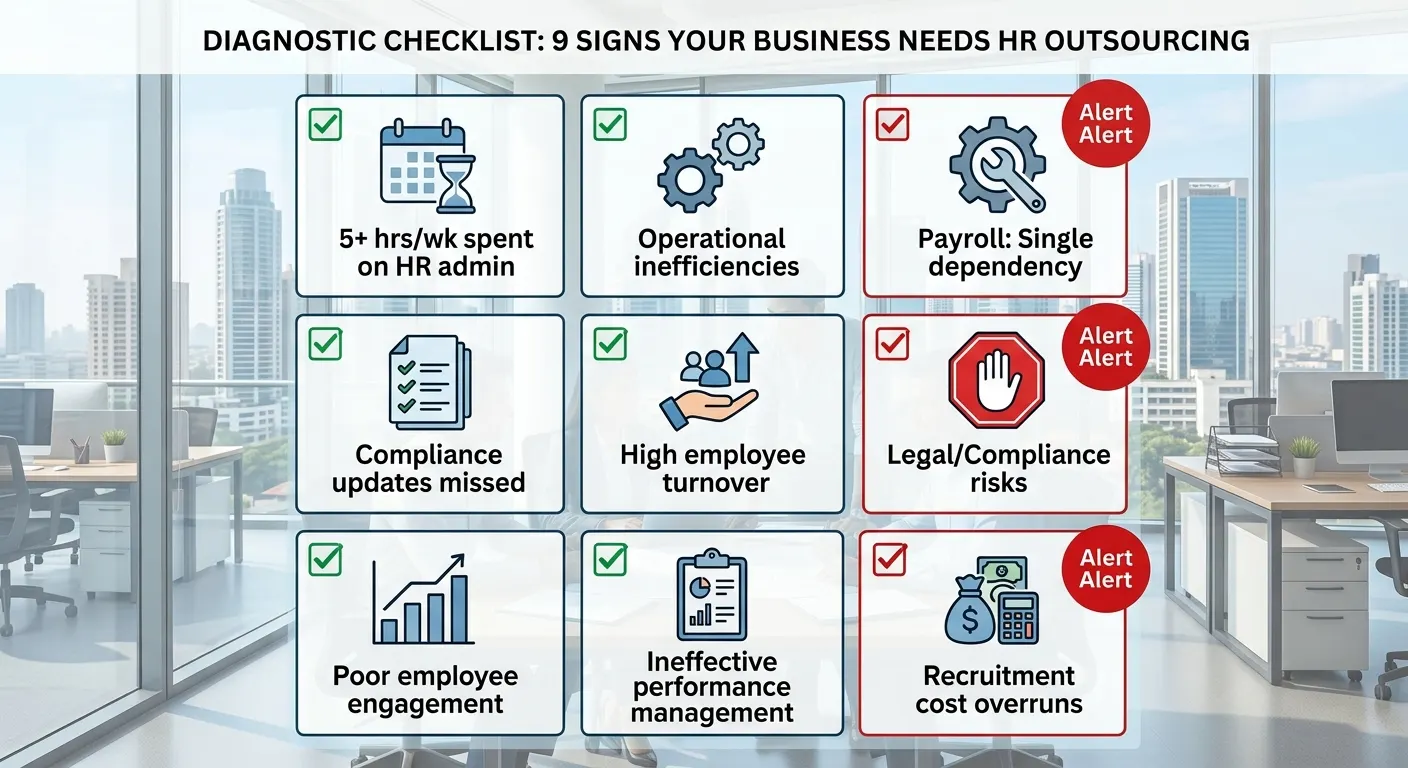
Pro Tip: Before evaluating pricing, determine whether your company is at the right stage for external HR management. Read our detailed guide on when your business is ready for HR outsourcing to benchmark your readiness.
Mistake 2: Outsourcing HR Without Clearly Defining Responsibilities
Another major misstep is kicking off an outsourcing engagement without defining exact boundaries between what your internal team manages and what the external HR consultant owns.
Without documented service level agreements (SLAs) and clarity on roles, operational confusion quickly follows. Employees do not know whom to approach for salary adjustments or leave policies. Internal department managers may assume the consultant is managing an employee grievance, while the consultant assumes internal management retains ownership. Important people management tasks inevitably slip through the cracks.
How to Avoid This Mistake
Before work begins, document a RACI matrix (Responsible, Accountable, Consulted, Informed) across all HR pillars:
| HR Functional Area | External HR Partner Scope | Internal Management Scope |
| Recruitment & Talent Acquisition | Sourcing candidates, screening resumes, scheduling interviews, drafting offer letters, and conducting reference checks. | Final candidate interview approvals, salary budget authorizations, and hiring decisions. |
| HR Operations & Onboarding | Maintaining employee files, managing attendance systems, organizing orientation, and issuing documentation. | Day-one team introductions, workstation setup, and role-specific job training. |
| Payroll & Statutory Compliance | Salary calculations, statutory deduction computations, Form 16 preparation, and regulatory filings. | Approving final monthly payout totals and releasing bank salary disbursements. |
| Performance Management | Designing KPI templates, appraisal workflows, review schedules, and manager evaluation guidelines. | Conducting direct performance conversations and providing regular constructive feedback. |
When both internal leadership and external consultants have explicit boundaries, accountability increases and execution becomes seamless.
Mistake 3: Treating Your HR Consultant Like an External Vendor Instead of a Business Partner
HR cannot function effectively in a silo. While external HR consultants bring industry best practices, labor law expertise, and structured frameworks, they still require deep visibility into how your company operates day-to-day.
A common mistake is contacting your HR partner only when an emergency arises—such as needing an immediate replacement hire, processing an abrupt employee termination, or responding to a compliance notice. This forces HR into a purely reactive role.
To deliver maximum value, your HR partner must understand:
- Core business objectives, revenue models, and growth projections
- Leadership expectations, workplace culture, and company values
- High-attrition departments and key operational bottlenecks
- Upcoming expansions, new product lines, or office relocations
How to Avoid This Mistake
Integrate your HR partner into strategic planning discussions early. For example, if your company plans to enter a new market, launch a sales push, or double technical headcount over the next two quarters, involve your HR consultant during initial planning.
Early involvement allows your HR team to proactively structure manpower planning, build hiring pipelines, align compensation benchmarks, update workplace policies, and map out training programs well before execution deadlines arrive. Treat HR outsourcing as a strategic leadership partnership rather than simple task delegation.
Mistake 4: Ignoring Employee Experience After Outsourcing HR
While management understands the business rationale for outsourcing HR, employees may interpret the transition differently if communication is handled poorly. If the change is unannounced, staff members may feel that HR has become distant, impersonal, or inaccessible.
Employees need immediate clarity regarding whom to contact for confidential grievances, salary queries, leave requests, performance reviews, or policy updates. Delayed responses or confusion over contact points can erode trust in company leadership.
Safety & Governance Note: Ensuring seamless communication also involves data protection. Ensure your provider adheres to strict data protocols; review our breakdown on data security and compliance risks in HR outsourcing to keep employee data protected.
How to Avoid This Mistake
Establish structured communication protocols from day one of the engagement:
- Clear Onboarding Announcement: Introduce the external HR partner to the entire organization, explaining their role, contact channels, and how they support staff.
- Dedicated Contact Portals: Provide employees with explicit email addresses or HRMS helpdesk portals for submitting daily queries.
- Defined Response Timelines: Establish standard SLAs for routine requests (e.g., salary slips within 24 hours, policy clarifications within 48 hours).
- Proactive Engagement: Schedule regular check-ins, employee pulse surveys, and policy orientation sessions so the HR team remains an active, supportive presence.
Effective HR outsourcing should make your HR department more organized, responsive, and supportive—never detached.
Mistake 5: Expecting HR Outsourcing to Fix Every People Problem Immediately
Companies often engage an HR consultancy when people issues have already escalated. Attrition may be high, employee files incomplete, job roles poorly defined, appraisals non-existent, and compliance records outdated.
A mistake leadership teams make is expecting these accumulated operational gaps to disappear overnight upon signing an HR contract. Real HR transformation requires systematic structuring, process implementation, and consistent management participation.
For example, while an external consultant can build an objective performance management system, internal managers must still take the time to deliver honest, constructive evaluations. Similarly, while HR can design employee retention strategies, internal company culture, leadership behavior, and competitive compensation remain decisive factors in retaining talent.
How to Avoid This Mistake
Work with your HR partner to establish a phased implementation roadmap based on immediate business priorities:
[Phase 1: Foundation] ➔ [Phase 2: Standardization] ➔ [Phase 3: Performance] ➔ [Phase 4: Scaling]
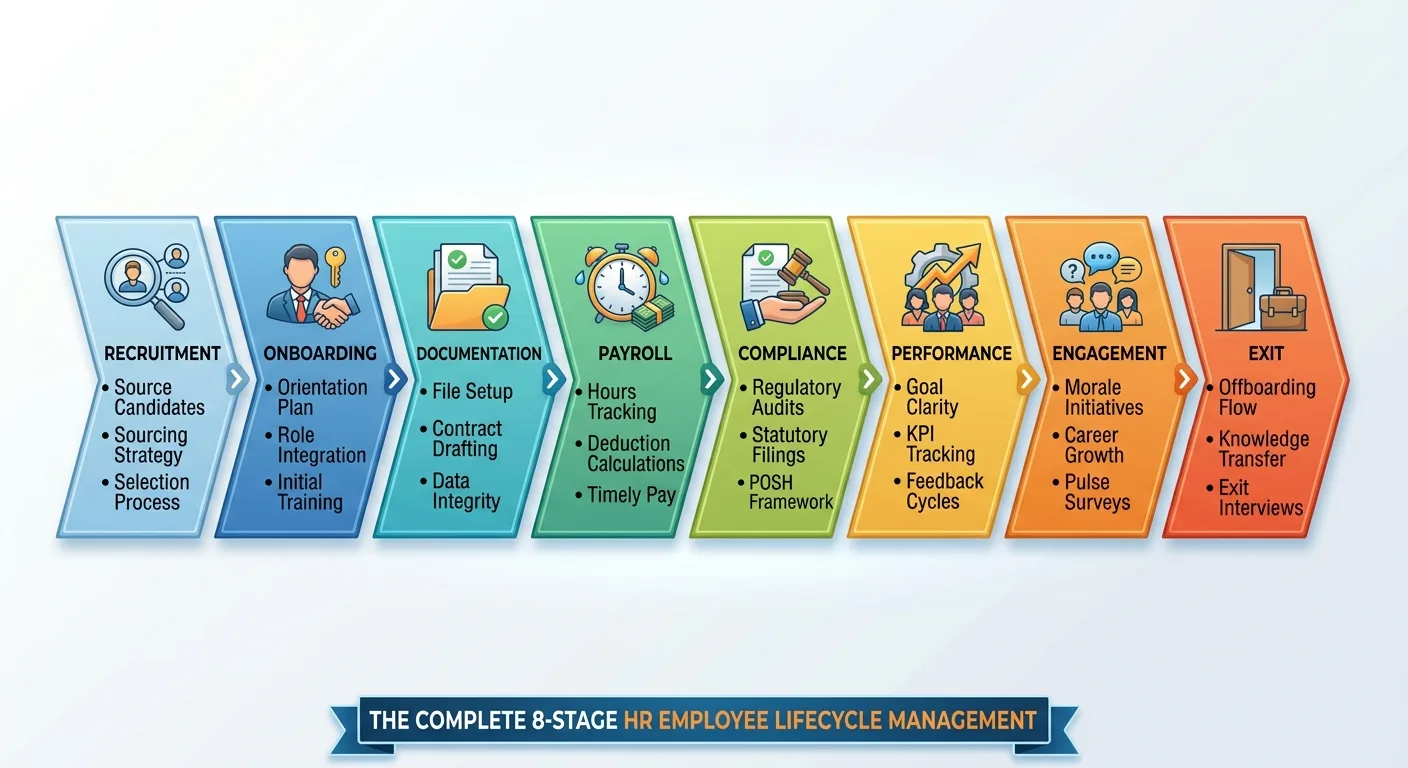
- Phase 1 (Foundation – Month 1): Conduct an initial compliance audit, organize employee documentation, and correct payroll processes. If you haven’t reviewed your statutory standing recently, conducting an HR audit for Indian compliance is the ideal starting point.
- Phase 2 (Standardization – Months 2–3): Standardize recruitment flows, publish clean employee handbooks, and institute structured onboarding.
- Phase 3 (Performance – Months 4–5): Implement role clarity, define KRAs/KPIs, and train managers on review frameworks.
- Phase 4 (Scaling & Retention – Month 6 Onward): Roll out engagement initiatives, leadership development, and strategic workforce planning.
A structured roadmap prevents burnout, manages team expectations, and builds a stable workforce foundation.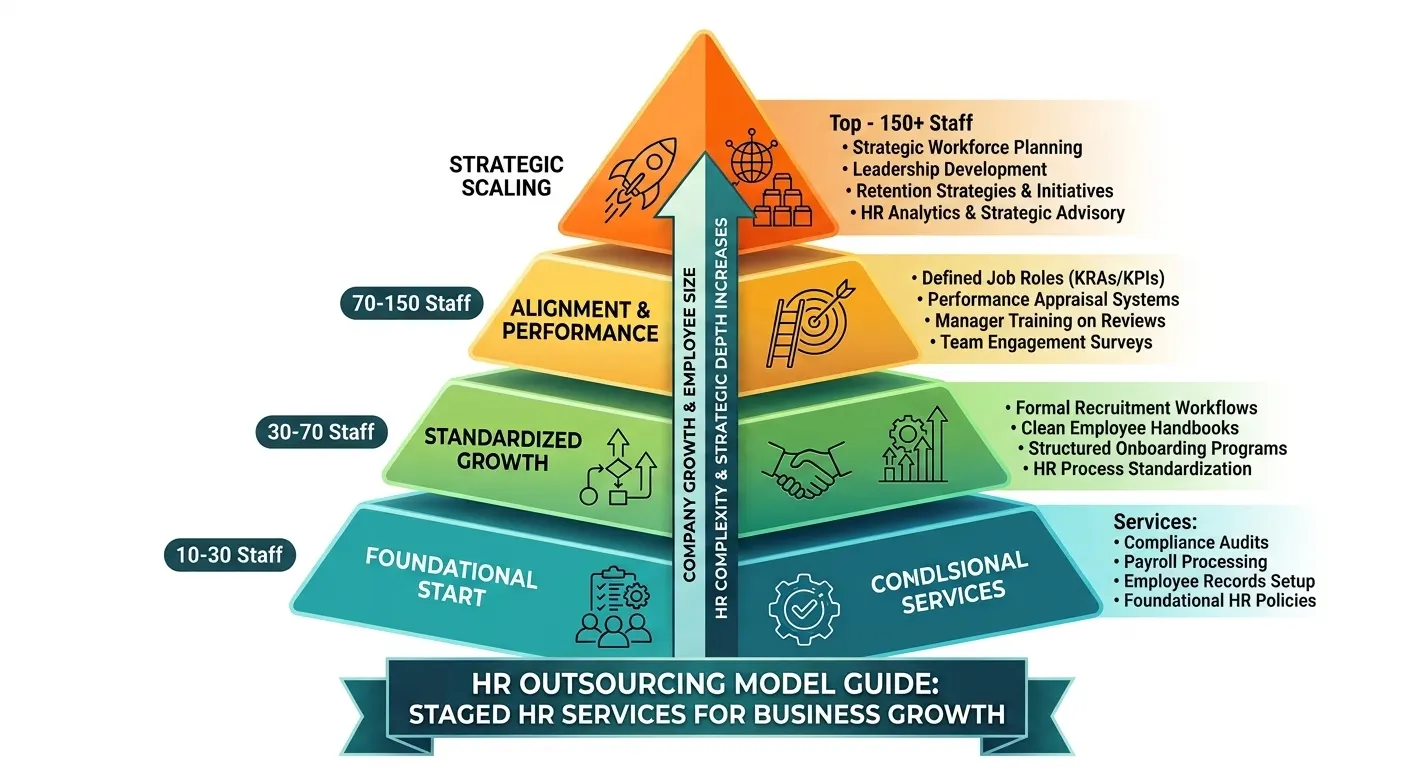
Red Flags to Watch Before Choosing an HR Outsourcing Partner
Before signing an agreement, pay close attention to early warning signs during vendor evaluations. If a prospective HR consultant exhibits any of the following traits, it indicates a high risk of operational failure:
- The provider talks only about price: Leading with discounts rather than asking about your workforce structure, attrition challenges, or scaling plans indicates cheap, transactional support.
- Scope of work is vague: Ambiguous service agreements without concrete deliverables lead to hidden costs, dropped responsibilities, and operational friction.
- No dedicated HR point of contact: Routing your employee queries through generic call centers or rotating junior representatives creates severe resolution delays.
- No defined escalation mechanism: Lack of clear protocols for urgent statutory issues, POSH complaints, or payroll disputes leaves your company legally vulnerable.
- No SLA or reporting mechanism: Professional partners provide regular operational metrics (e.g., time-to-hire, query resolution speed, compliance health). Avoid vendors with zero performance metrics.
- They cannot explain their compliance process: Inability to clearly outline how they manage statutory obligations like EPF, ESI, Professional Tax, or local labor laws puts your firm at risk of legal penalties.
- They use the same HR templates for every client: One-size-fits-all employee handbooks or performance frameworks fail to account for your unique business culture, industry demands, or company size.
- They cannot explain what happens when the engagement ends: Reliable consultants always define a clear offboarding framework to ensure all employee data and compliance files are safely transitioned back.
What Should You Look for in an HR Outsourcing Partner?
The right HR partner should do far more than manage payroll or forward resumes. They should serve as an extension of your leadership team, building systems that scale alongside your company.
When evaluating potential HR consulting firms, confirm that they provide comprehensive capability across:
- Talent Acquisition & Sourcing: Structured hiring processes, candidate screening, and onboarding workflows.
- Payroll & Statutory Compliance: Flawless payroll processing, tax filings, and regulatory adherence. For deeper details on regulatory standards, review our guide on payroll compliance rules and laws in India.
- Policy Design & Employee Handbooks: Tailored workplace policies that protect the business and set clear expectations.
- Performance Management Systems: Practical KPI frameworks, appraisal cycles, and manager guidance.
- Strategic Advisory: Custom workforce planning, grievance management, and executive guidance.
Most importantly, avoid partners that offer rigid, cookie-cutter templates. Your HR partner should adapt their processes to match your company size, operational style, and growth targets.
HR Outsourcing Should Help Your Business Scale
When HR infrastructure is weak, businesses suffer indirect friction. Time-to-hire drags on, leadership spends excessive hours resolving interpersonal disputes, compliance risks mount, and top performers grow frustrated by a lack of clarity.
Strong HR systems provide the structural foundation required for sustainable business expansion. For growing organizations, outsourcing HR gives you immediate access to senior expertise and robust systems without the heavy overhead of building a large internal HR department from scratch.
By selecting the right partner, establishing clear boundaries, maintaining open communication, and treating HR as a strategic priority, you convert your HR operations from an administrative burden into a competitive advantage.
Build a Stronger HR Foundation with The Vedant Resources
At The Vedant Resources, we specialize in helping growing businesses build practical, compliant, and scalable HR systems tailored to their operational needs.
Whether you require targeted support for payroll management, statutory compliance, employee policy creation, performance management frameworks, or full end-to-end HR outsourcing services, our senior HR consultants work as an extended partner to your organization.
Don’t wait for a compliance audit or talent retention issue to slow your growth momentum.
Schedule an HR Consultation with The Vedant Resources Today to discover how structured HR processes can simplify operations and help your business scale.
Read More Related Articles
- When Should You Outsource HR? Signs Your Business Is Ready for HR Outsourcing
Relevance: Helps founders evaluate key indicators—such as administrative overload, slow recruitment, or compliance gaps—to confirm if outsourcing is the right immediate step. - Is HR Outsourcing Safe? Data Security, Compliance & Risks Explained
Relevance: Breaks down data confidentiality, non-disclosure agreements, and risk mitigation strategies when sharing employee data with an external HR provider. - HR Audit Benefits: Improve Documentation, People Processes, and Business Readiness
Relevance: Outlines how to conduct an initial HR health check to fix compliance gaps and organize documentation before starting an outsourcing partnership. - Payroll Compliance in India: Rules, Laws & Common Mistakes
Relevance: Details statutory obligations—including EPF, ESI, Professional Tax, and TDS—enabling leadership to verify that an external partner meets legal standards.