

As businesses grow, people-related decisions become more complex, yet many companies wait until a serious problem appears before seeking HR Advisory Services in India. High employee attrition, unclear roles, inconsistent performance reviews, policy disputes, leadership gaps and compliance concerns rarely appear overnight. They usually develop slowly because HR systems have not evolved at the same pace as the business. For growing SMEs, the real risk of skipping HR advisory is not one dramatic failure. It is a series of small, unstructured decisions that gradually affect productivity, employee experience, leadership bandwidth and business growth.
The challenge is simple: what works for a company with 20 employees may not work when the workforce reaches 50, 100 or 200.
That is where strategic HR advisory becomes valuable.
What Does It Mean to Skip HR Advisory?
Many organisations have people handling HR activities but still lack strategic HR direction.
There is an important difference.
HR administration focuses on everyday tasks such as attendance, documentation, onboarding, payroll inputs and employee queries. HR advisory looks at the systems behind those activities.
A strategic HR advisor may help leadership answer questions such as:
How should departments be structured? Why are employees leaving? Are managers measuring performance consistently? Do policies actually work in practice? Which roles will the business need next year? Is the current HRMS supporting or slowing the team down?
In other words, strategic HR advisory services help organisations diagnose people-related problems, design stronger frameworks and ensure HR decisions support wider business objectives.
Why HR Problems Become More Visible as Companies Grow
Informal HR practices often work surprisingly well when a business is small.
Founders know most employees personally. Managers can solve problems directly. Roles are flexible. Recruitment happens only occasionally, and performance is often discussed informally.
Growth changes that.
As the workforce expands, more managers make people decisions. Departments become larger. New roles are created. Employees expect clearer policies and career paths. Performance becomes harder to evaluate consistently.
The systems that once felt flexible can start creating confusion.
Growth itself is not necessarily the problem.
Growth usually exposes HR processes that were never designed to scale.
Companies that recognise these gaps early can redesign their systems. Companies that ignore them often end up solving the same people problems repeatedly.
7 Hidden Risks of Skipping HR Advisory
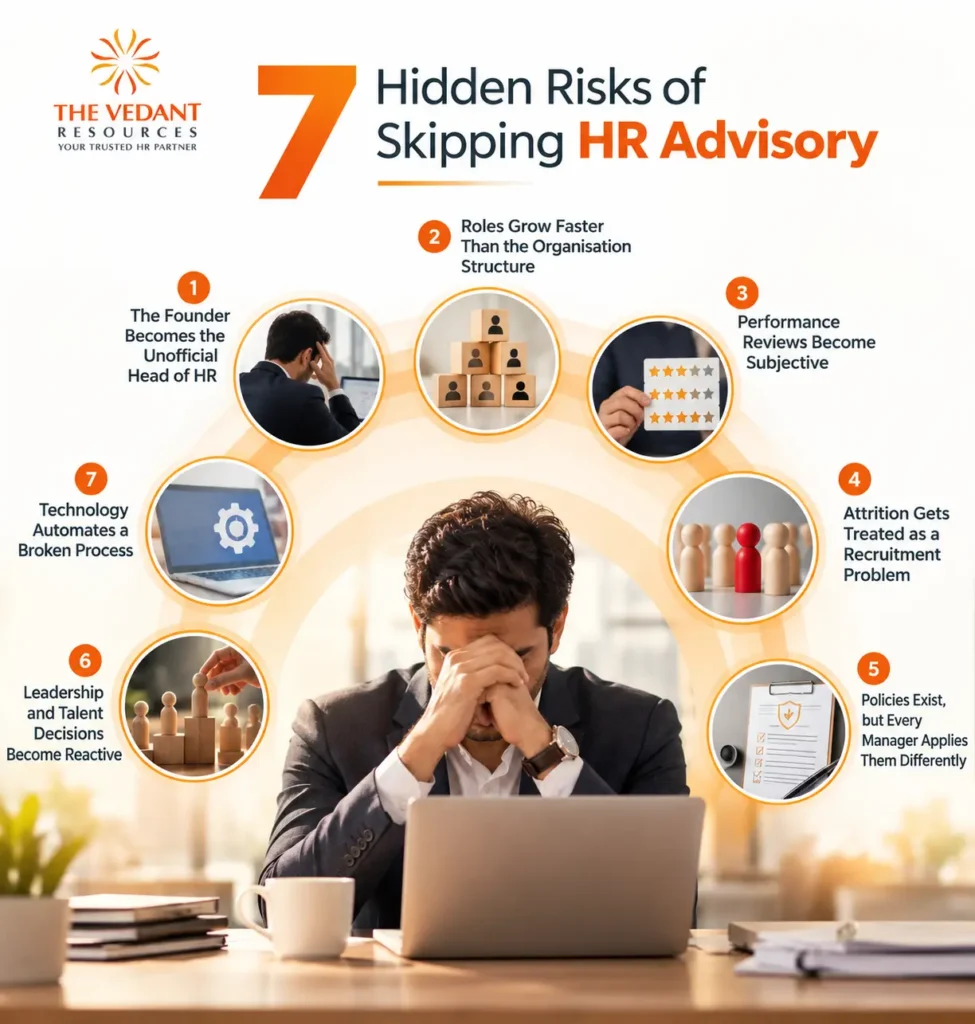
1. The Founder Becomes the Unofficial Head of HR
This is common in growing SMEs.
An employee has a salary concern, so it reaches the founder. A manager is unsure how to handle a performance issue, so leadership steps in. A senior employee threatens to leave, and the promoter becomes personally involved.
One issue may seem manageable.
But when similar escalations happen every week, leadership starts spending significant time on problems that should already have a defined HR process.
This is one of the strongest signs that a business may need HR advisory for SMEs.
The goal is not to remove leadership from people decisions. It is to ensure leadership is involved in the right decisions rather than becoming the default escalation point for routine issues.
2. Roles Grow Faster Than the Organisation Structure
Companies often hire because the workload is increasing.
But hiring another employee does not automatically solve a structural problem.
Without clear organisation design, growing businesses may experience overlapping responsibilities, unclear reporting lines, duplicated work and slow decision-making.
One manager believes a task belongs to operations. Another thinks it belongs to sales. Employees receive instructions from multiple people. New positions are added without clearly defining how they fit into the wider organisation.
Strategic HR advisory can help review reporting structures, roles, job responsibilities and workforce requirements before another round of hiring begins.
Good workforce planning services should answer more than, “Who do we need to hire?”
They should also ask, “Why does this role exist, who should it report to, and how will success be measured?”
3. Performance Reviews Become Subjective
Performance management often becomes inconsistent when businesses scale.
One manager rates employees based on targets. Another values attitude. Another manager gives almost everyone the same rating to avoid difficult conversations.
Without a common framework, employees may not understand what good performance actually looks like.
A structured system generally connects:
Role clarity → Goals → KRAs/KPIs → Review cycles → Feedback → Development
This is where performance management consulting can add value.
The objective is not to create complicated appraisal forms. It is to ensure employees understand expectations, managers assess people consistently, and leadership has better visibility into performance.
When performance systems remain informal, strong employees may feel overlooked while underperformance can continue for too long.
4. Attrition Gets Treated as a Recruitment Problem
An employee resigns.
The immediate response is often: “Find a replacement.”
Then another employee leaves.
And another.
Recruitment can replace people, but it cannot always solve the reason people are leaving.
Recurring attrition may be connected to manager capability, compensation, career progression, workload, role clarity, culture or employee experience.
This is where employee engagement consulting and talent management consulting become more relevant than simply increasing recruitment activity.
Instead of asking only:
“Where do we find the next candidate?”
Leadership should also ask:
“Why are the people we already hired choosing to leave?”
An HR advisor can help identify patterns, review employee feedback and determine whether attrition is a hiring issue or a symptom of a deeper organisational problem.
5. Policies Exist, but Every Manager Applies Them Differently
Many organisations have HR policies.
The problem is that those policies may exist only in a document.
One manager approves an exception. Another follows the policy strictly. A third manager interprets the same rule differently.
Over time, employees begin comparing how similar situations were handled across teams.
This can create dissatisfaction and unnecessary escalations.
A strong HR policy consulting approach should ensure policies are not only documented but also practical, understandable and consistently implemented.
Areas such as leave, attendance, promotions, performance improvement, employee grievances and disciplinary processes require clarity.
A policy is useful only when managers and employees understand how it actually works.
6. Leadership and Talent Decisions Become Reactive
Growing businesses are often busy solving today’s vacancies.
But strategic workforce planning looks further ahead.
Which roles will become critical in the next 12 months?
Who could lead a new business unit?
Which managers are ready for larger teams?
Where are capability gaps?
Who can step into key roles if a senior employee leaves?
Without these conversations, companies may become overly dependent on a few individuals.
Succession planning, leadership development and talent reviews help businesses reduce that dependency.
This is particularly important when an SME is expanding into new locations, launching new services or building additional management layers.
Strategic HR advisory helps shift the conversation from “Who do we need right now?” to “What capabilities will the business need next?”
7. Technology Automates a Broken Process
HRMS platforms can make HR more efficient.
But software cannot fix an unclear process by itself.
If performance criteria are poorly defined, putting them into software does not make them better. If leave approvals are confusing, digitising the same workflow may simply make the confusion faster.
The right sequence is:
Diagnose → Design → Implement → Automate
HR technology should support good HR processes rather than replace the need to create them.
This is why HR consulting services in India increasingly involve both process design and technology decisions.
The question should not simply be, “Which HRMS should we buy?”
It should be, “What HR process are we trying to improve?”
The Cost of Waiting: Small HR Gaps Become Bigger Business Problems
Most HR issues are easier to solve early.
An unclear role today may become an accountability issue later. An informal appraisal process may eventually create performance disputes. Weak managers can contribute to attrition. Inconsistent policies can trigger employee grievances.
The business impact is often gradual.
A company may continue growing while these gaps exist, but leadership spends more time resolving preventable problems.
This is why the purpose of HR advisory is not to create more paperwork.
It is to identify where people systems are beginning to strain before those gaps start affecting growth.
Signs Your Growing Business May Need HR Advisory
Your organisation may benefit from strategic HR support if several of these situations are happening at the same time:
- Founders regularly intervene in employee or manager issues.
- Attrition continues despite constant recruitment.
- Managers lack clear KRAs or KPIs.
- Employees receive different interpretations of the same policy.
- Organisation structure has not evolved with headcount.
- Performance reviews feel inconsistent or ineffective.
- Recruitment is driven mainly by urgent vacancies.
- Compensation decisions lack a clear framework.
- Your HR team is strong at execution but lacks strategic direction.
- Leadership does not have a clear workforce or succession plan.
If several of these signs feel familiar, hiring another HR administrator may not solve the core issue.
The organisation may need better diagnosis, frameworks and strategic direction first.
HR Advisory vs HR Outsourcing vs CHRO Services: What Do You Need?
These services solve different problems.
HR Advisory is generally useful when a business needs to diagnose or improve specific HR areas such as policies, performance systems, organisation structure, engagement, compliance or HR technology.
HR Outsourcing is more relevant when recurring HR processes need to be managed externally.
CHRO or Head HR Services provide a higher level of ongoing strategic HR leadership.
A company can also combine these models.
For example, an internal HR Manager may handle daily employee matters while an external advisor helps redesign performance management, policies or organisation structure.
If your requirement is to strengthen HR frameworks and resolve specific people-process gaps, explore HR Advisory Services in India.
What Should Strong HR Advisory Actually Deliver?
HR advisory should result in tangible improvement, not simply recommendations in a presentation.
A strong engagement should usually move through a process such as:
Problem → Diagnosis → Framework → Implementation → Review
Depending on the organisation, outcomes may include an HR audit, revised policies, a clearer organisation structure, performance-management frameworks, workforce plans, employee-engagement initiatives, talent-development plans, HRMS recommendations, compliance improvements or restructuring support.
The value of strategic HR advisory services lies in turning business and people problems into practical systems the organisation can actually use.
How The Vedant Resources Supports Growing Businesses
The Vedant Resources (TVR) works with MSMEs and growing organisations that need to strengthen their people systems as the business scales.
Its HR Advisory support includes areas such as HR policies and documentation, employee engagement, talent and succession planning, performance management, learning and development, HR technology, compliance, organisational restructuring and HR audits.
The objective is not to add unnecessary layers to HR.
It is to identify what is missing, strengthen the processes that matter and help the organisation build HR systems that can support future growth.
Businesses looking for structured support can explore HR Advisory Services from The Vedant Resources.
Frequently Asked Questions About HR Advisory Services
What do HR Advisory Services in India include?
HR Advisory Services can include HR audits, policies and processes, organisation structure, performance management, employee engagement, talent and succession planning, workforce planning, HR technology, compliance support and organisational restructuring. The exact scope should depend on the company’s current challenges.
How is HR advisory different from HR outsourcing?
HR advisory primarily focuses on diagnosing problems, designing frameworks and improving HR systems. HR outsourcing focuses more on managing recurring HR processes on behalf of the business. Some organisations use both models together.
When should a growing SME hire an HR advisor?
An SME should consider HR advisory when recurring people issues begin affecting leadership time, employee retention, performance, organisation structure or business growth. It can be particularly useful when the internal HR team executes daily work effectively but needs strategic guidance.
Can an HR advisor work with an existing HR team?
Yes. HR advisory does not necessarily replace the internal HR team. An advisor can work with existing HR professionals and leadership to strengthen policies, processes, performance systems, organisation design and other strategic areas.
Can HR advisory help reduce employee attrition?
HR advisory cannot guarantee lower attrition, but it can help identify underlying causes such as compensation, manager quality, role clarity, employee experience, career development or performance processes. Businesses can then take more informed action rather than relying only on replacement hiring.
Is HR advisory useful only for large companies?
No. Growing SMEs can benefit significantly because they often reach a stage where informal HR systems stop working, even though they may not yet need a large internal strategic HR team.
The Biggest Risk Is Not “No HR”—It Is Growing Without the Right HR Structure
Most growing businesses eventually hire more employees.
The real question is whether the systems managing those employees are evolving at the same pace.
When organisation structure, policies, performance systems, workforce planning and talent decisions remain informal, small gaps can become recurring business problems.
HR advisory gives leadership an opportunity to identify those gaps earlier and build better systems before growth makes them harder to fix.
Is Your HR Function Ready for the Next Stage of Growth?
Do not wait for recurring attrition, manager conflicts, unclear accountability or compliance gaps to become the signal that your HR system needs attention.
Explore HR Advisory Services from The Vedant Resources to identify people-process gaps, strengthen your HR frameworks and build an organisation that is better prepared to scale.
Build stronger systems. Make better people decisions. Grow with clarity.
Think Beyond HR. Think TVR.