

Your company has an HRMS. Attendance is digital. Employees can apply for leave online. Payroll runs through software. Yet your HR team still spends hours updating spreadsheets, checking attendance manually, correcting employee data and answering routine employee queries.
If technology was supposed to reduce HR workload, why does the team still feel overloaded?
This is one of the most common HRMS implementation challenges growing businesses face. The problem is not always the software itself. In many organisations, HR technology is added on top of old processes, disconnected data and manual workflows instead of replacing them.
The real question is no longer, “Do we have an HRMS?”
It is:
“Is our HRMS actually making HR easier?”
What Should a Good HRMS Actually Reduce?
A good HRMS should not simply move HR activities from paper to a screen. It should reduce the amount of repetitive work required to manage employees.
For a growing business, that means less dependency on spreadsheets, fewer duplicate entries, smoother attendance and leave processing, easier payroll inputs, better employee self-service and faster access to reliable HR reports.
If your HR team has software but still maintains separate Excel sheets for attendance, payroll, employee records or management reporting, the business may have digitised HR without actually simplifying it.
A strong HRMS should gradually become the single source of reliable employee information, rather than another system that HR has to check against existing records.
7 Signs Your HRMS Is Creating More Work Instead of Reducing It
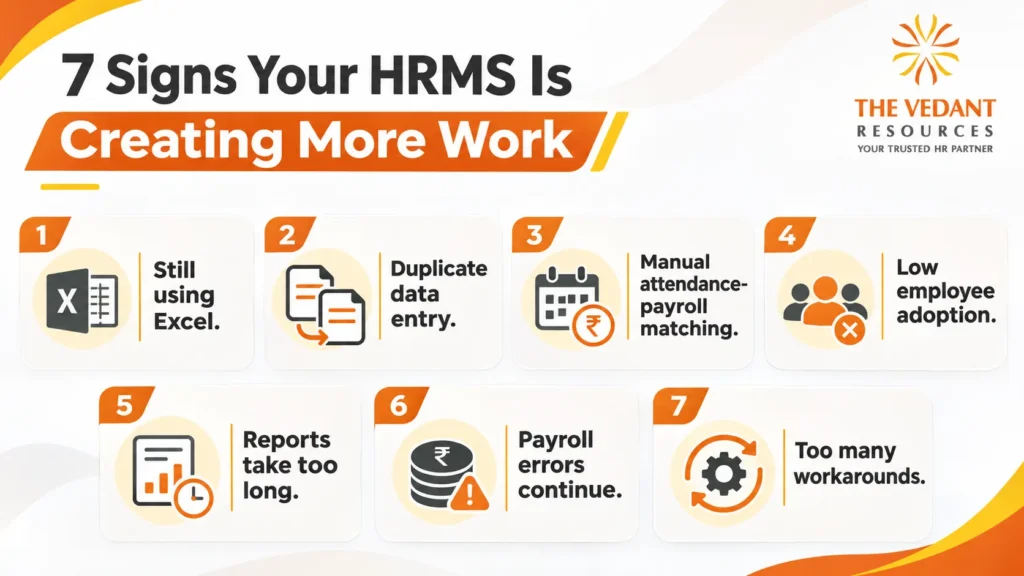
1. Your HR Team Still Depends Heavily on Excel
Excel itself is not the problem. It becomes a warning sign when spreadsheets remain essential for processes that the HRMS was expected to handle.
If your team regularly exports data from the system, modifies it manually and uploads it elsewhere, there may be a process or configuration gap.
For example, HR may record leave in the HRMS but maintain a separate leave tracker. Attendance may be digital, but monthly payroll still depends on a manually cleaned spreadsheet.
In that situation, the HRMS has not replaced the old process. It has simply added another step.
2. Employee Data Has to Be Entered More Than Once
Consider what happens when a new employee joins.
Is the employee’s information entered into the HRMS and then entered again into payroll, attendance, onboarding records and spreadsheets?
Repeated data entry increases the chance of mismatch.
A connected employee data management system should allow core employee information to flow through relevant HR processes wherever possible.
The more often HR has to recreate the same information, the less value the organisation is getting from automation.
3. Attendance and Payroll Still Need Manual Reconciliation
Attendance and payroll are closely connected.
Leave, loss of pay, overtime, shifts, joining dates and employee exits can all affect salary calculations.
If HR still needs to export attendance data, correct it manually and then prepare separate payroll inputs every month, your payroll and attendance integration may not be working effectively.
This is especially important as headcount grows. A process that is manageable with 20 employees can become difficult to control at 100 or 200 employees.
4. Managers and Employees Avoid Using the HRMS
An HRMS only creates value when people actually use it.
If managers approve leave through email or WhatsApp instead of the system, employees ask HR for payslips they could access themselves, or HR enters requests on behalf of employees, there is an HRMS adoption problem.
Sometimes the issue is training. Sometimes workflows are too complicated. In other cases, the system has not been configured around the way people actually work.
Whatever the reason, software that users avoid ultimately transfers the work back to HR.
5. Management Reports Still Take Hours to Prepare
Leadership should not have to wait several days for basic workforce information.
Questions such as current headcount, department-wise employee strength, absenteeism, pending confirmations or payroll cost should be easier to answer when employee data is structured correctly.
If HR still combines multiple spreadsheets every time management asks for a report, the issue may lie in data quality, reporting configuration or disconnected systems.
A useful HRMS should help turn employee data into information that supports decisions.
6. Payroll Errors Continue Despite Automation
Automation does not automatically guarantee accuracy.
An HRMS can calculate quickly, but it still depends on the information and rules entered into it.
If employee data is incorrect, attendance has not been closed properly or salary structures are outdated, software may simply process incorrect information faster.
That is why strong HR technology needs a reliable flow:
Employee Data → Attendance → Payroll Inputs → Verification → Approval
Technology should strengthen the process, not eliminate the need for process control.
7. Every New HR Requirement Needs a Workaround
Growing businesses change.
A new location opens. Shift structures change. Reporting hierarchies evolve. Leave policies are revised. Performance cycles become more formal.
If every business change requires another spreadsheet, manual approval or temporary workaround, your current HRMS may not be configured to scale with the organisation.
This does not automatically mean you need new software. It does mean the current system needs to be reviewed.
Why Do HRMS Problems Continue Even After Implementation?
Many HRMS software challenges begin before the system goes live.
A business may select technology before clearly defining its HR processes. Employee data may be migrated without proper cleaning. Attendance, leave and payroll modules may operate independently. Managers may receive limited training. After implementation, no one may take clear ownership of reviewing workflows and reporting.
That is why successful HRMS implementation in India should not be treated as an IT installation alone.
It sits at the intersection of:
Process + Data + Configuration + Integration + Adoption
If one of these areas is weak, even capable software can create frustration.
Is Your HRMS Working? Use This Simple Efficiency Test
Question | What You Ideally Want to See |
Is employee data entered multiple times? | Rarely |
Are spreadsheets essential for payroll? | No or minimal |
Does attendance connect smoothly with payroll? | Yes |
Can employees access routine HR information themselves? | Yes |
Do managers use digital approval workflows? | Yes |
Can HR generate key reports without manual consolidation? | Yes |
Are payroll corrections frequent? | No |
Can the system support growth and new locations? | Yes |
If several answers fall on the wrong side, buying another HRMS should not necessarily be the first step.
The first step should be identifying where the current HR process is breaking.
Don’t Automate a Broken HR Process
One of the biggest mistakes businesses make with HR automation services is assuming technology can correct an unclear process.
It cannot.
If leave rules are inconsistent, digitising them will not make them consistent.
If appraisal criteria are unclear, introducing a performance module will not automatically create a fair performance-management process.
If employee information is incomplete, moving it to a new system will not make the data reliable.
A better sequence is:
Diagnose → Simplify → Configure → Integrate → Train → Measure
Technology works best after the business understands how the underlying HR process should function.
Also Read
If your organisation is growing but its HR processes have not evolved at the same pace, read What Happens When Growing Companies Skip HR Advisory? The Hidden Risks No One Talks About.
It explains why unclear processes, inconsistent policies and weak HR structures often become more visible as headcount grows.
What Should You Fix Before Replacing Your HRMS?
Before investing in another platform, review the current environment.
Start by mapping how employee information moves from joining to attendance, leave, payroll, performance and reporting. Identify where information is duplicated, where approvals happen outside the system and where employees or managers regularly bypass the HRMS.
Then review the quality of employee data and system integrations.
Finally, ask whether people have been trained to use the platform and whether management reports are configured around actual business needs.
Sometimes the right solution is a new HRMS.
Sometimes it is better HRMS integration, configuration and adoption of the platform you already have.
Knowing the difference can prevent the business from replacing technology without fixing the underlying problem.
When Is It Time to Consider a New HRMS?
A replacement may make sense when the existing system cannot support essential integrations, organisational growth, required reporting, employee self-service or core HR workflows.
It may also be necessary when limitations in configuration or support repeatedly force the team back into manual processes.
However, the decision should come after a structured assessment.
The objective should not be to find software with the longest feature list. It should be to find an HRMS for SMEs and growing businesses that fits actual processes and can scale as the organisation changes.
How The Vedant Resources Supports Better HR Technology
HR technology should make your HR team more efficient, not give them another system to manage.
The Vedant Resources provides HRMS Technology Services that support areas such as employee data management, payroll and compensation, attendance and leave, recruitment and onboarding, performance management, reporting and employee self-service.
The focus should always remain on the business outcome: creating connected HR processes, reducing unnecessary manual work and improving access to reliable workforce information.
For growing organisations, effective HR technology solutions in India require more than software selection. They require the right process, configuration, adoption and ongoing review.
Frequently Asked Questions About HRMS Implementation Challenges
What are the most common HRMS implementation challenges?
Common challenges include poor data quality, disconnected modules, duplicate data entry, weak integrations, low user adoption, unclear workflows and limited reporting. Many of these problems arise from the implementation process rather than the software alone.
Why is our HRMS creating more manual work?
This usually happens when the HRMS operates alongside old spreadsheets and manual workflows. If systems are not properly integrated or configured, HR may end up maintaining both digital and manual processes.
How do I know if our HRMS is working effectively?
A well-functioning HRMS should reduce repetitive data entry, improve employee self-service, connect core HR processes, reduce manual reconciliation and make important workforce reports easier to access.
Should we replace our HRMS if employees are not using it?
Not immediately. First review usability, training, workflows, configuration and employee adoption. If the underlying problem is implementation rather than capability, replacing the software may recreate the same issue.
Can HRMS Technology Services help a growing SME?
Yes. As headcount increases, integrated HR technology can help growing businesses organise employee information, attendance, leave, payroll inputs, onboarding, reporting and self-service more consistently.
Your HRMS Should Reduce Work—Not Relocate It
A company can have HR software and still run HR manually.
The real measure of HRMS success is not the number of modules activated. It is whether technology reduces repetitive work, improves data reliability, connects important HR processes and gives employees, managers and leadership easier access to the information they need.
If your HR team is spending more time managing the system than benefiting from it, it may be time to review how the HRMS has been implemented.
Is Your HRMS Actually Working for Your HR Function More Efficient?
If your HR team is still spending hours managing spreadsheets, reconciling attendance, correcting employee data or preparing manual reports, it may be time to review your HRMS setup.
At The Vedant Resources (TVR), we help growing businesses review their HR processes, improve HRMS configuration and adoption, strengthen integrations and build connected HR technology systems.
Before investing in another HRMS, let’s understand whether your existing system is delivering the value your business needs.
Connect with TVR to discuss your HRMS challenges and identify opportunities to make your HR function more efficient.
Your HRMS should reduce the workload—not become part of it.
Think Beyond HR. Think TVR.